

Swarm Robotics for Disaster Rescue
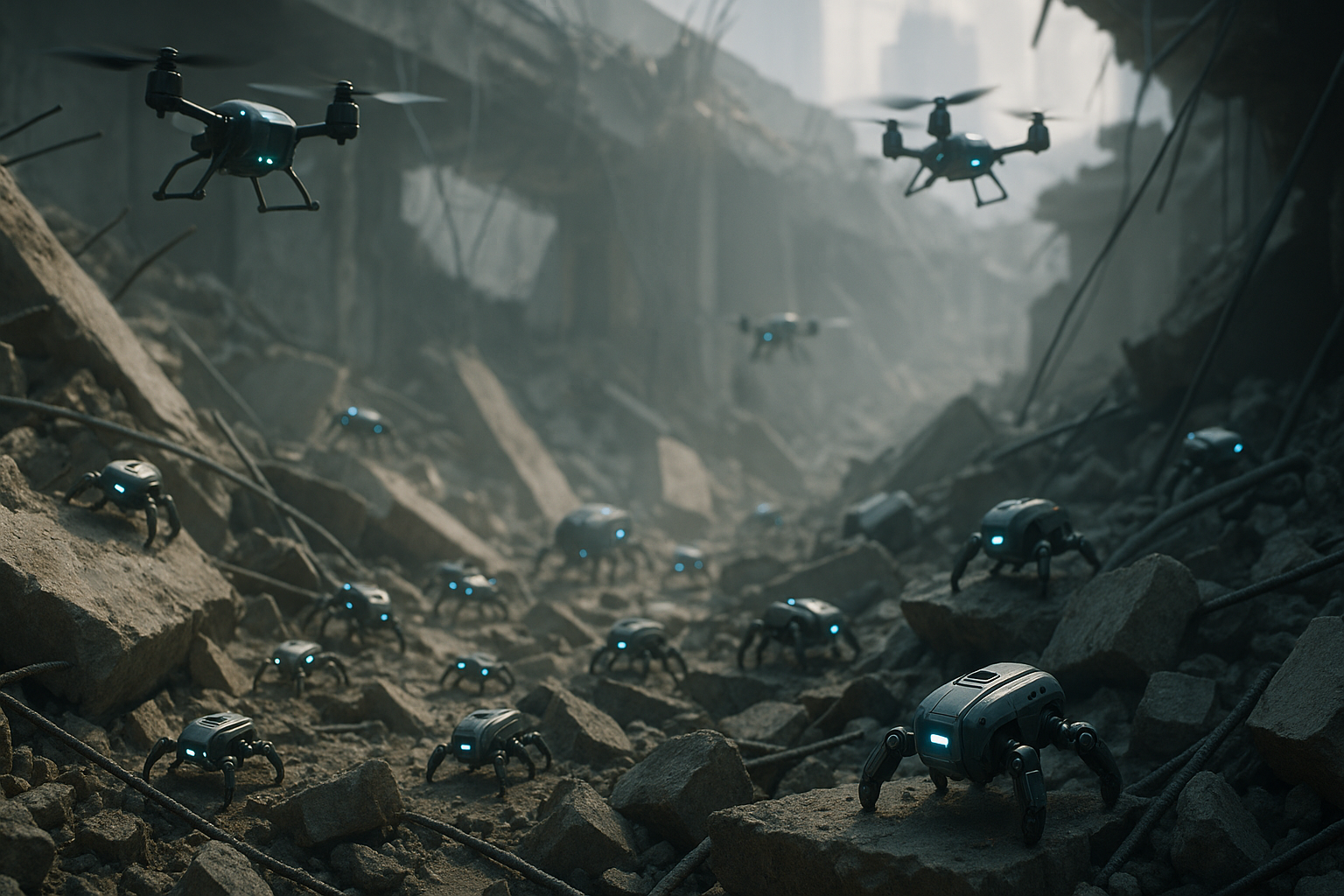
When disaster strikes — from earthquakes to building collapses — seconds count. Traditional rescue operations face dangerous, unstable terrain. That’s where swarm robotics comes in: tiny autonomous robots working together like ants or bees to search, navigate, and save lives.
Swarm robotics is inspired by nature. Just as ants collaborate to find food or birds coordinate in flight, swarm robots communicate and self-organize without a central controller. These small bots — sometimes just inches long — can spread across a disaster site, mapping debris, locating survivors, and forming ad hoc sensor networks.
The advantage? Redundancy and scalability. If one robot fails, the swarm continues. And since each unit is inexpensive and simple, the system becomes robust and cost-effective.
In disaster zones, swarms can adapt dynamically. If a passage is too narrow, smaller robots go in. If communication is lost, the swarm can reroute data through nearby units, creating a living mesh network. Some systems even use drones and ground robots in coordination — one to scout from above, the other to crawl beneath the rubble.
Researchers are also developing bio-inspired features: robotic cockroaches that scuttle through cracks, snake-like bots for tight spaces, and flying micro-drones with collision avoidance.
The field faces challenges like coordination algorithms, energy efficiency, and real-time decision-making. But with advances in AI and edge computing, swarms are becoming more intelligent and autonomous.
As climate disasters and urban crises increase, swarm robotics could become a vital ally — not just watching from the sidelines, but diving in headfirst to save lives, together.


